



How oral appliances work
Mandibular advancement device: how it actually works
The short answer
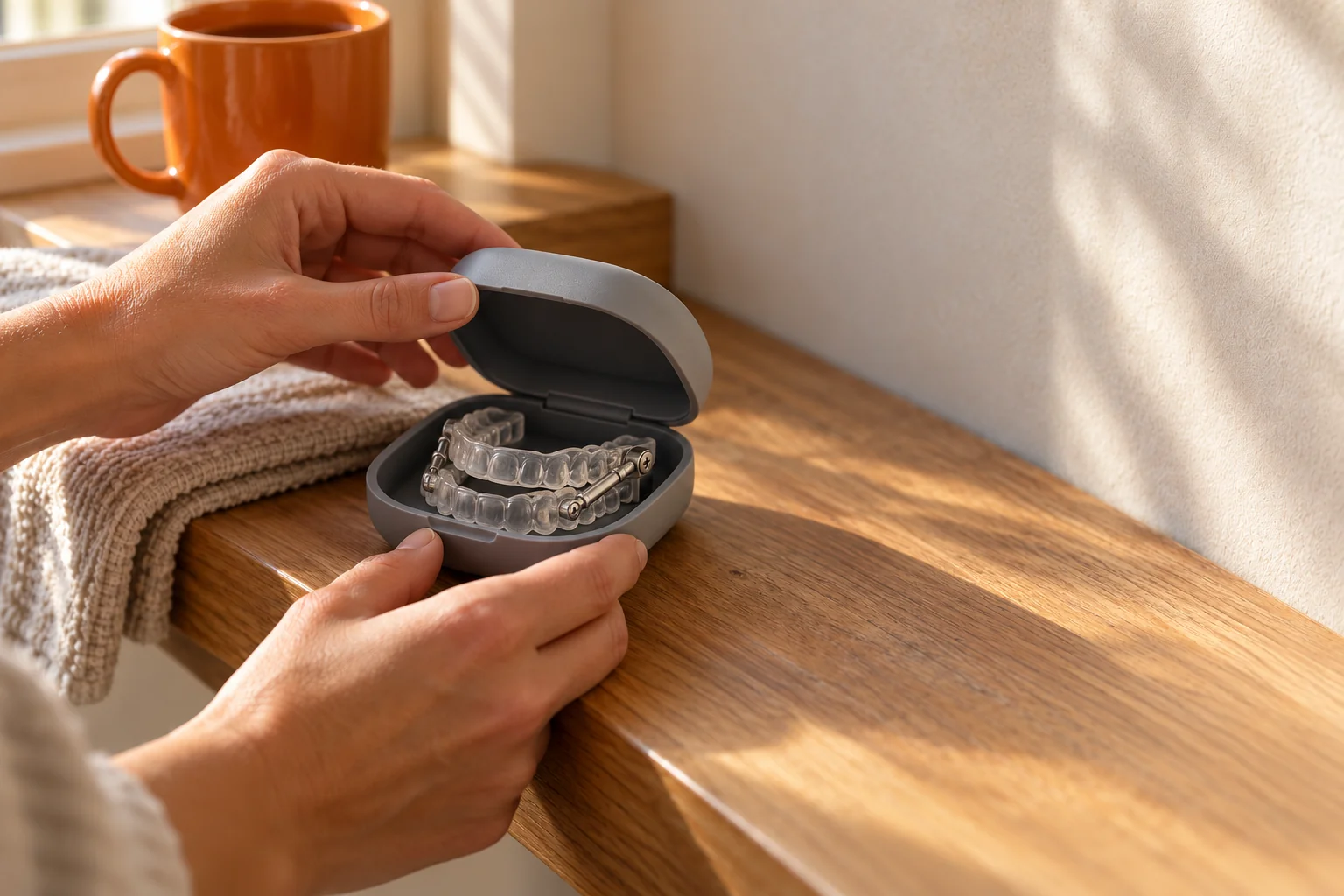
A mandibular advancement device is a two-piece custom splint, made by a dentist, that holds your lower jaw and tongue forward during sleep. That small shift tightens the soft tissue of your throat and keeps your airway open when your muscles relax. Your dentist then adjusts it over several weeks until a follow-up sleep test confirms it is working.
The essentials
Key takeaways
The core of this article, in a few lines.
- A mandibular advancement device holds your lower jaw and tongue forward so your airway stays open when your throat muscles relax in sleep.
- Clinical guidelines favor a custom, adjustable device from a qualified dentist over a store-bought guard.
- The device is tuned in small steps over several weeks, then checked with a follow-up sleep test that only means something if you wear it every night.
- Early jaw soreness is common, and slow bite changes over years are why regular dental check-ins matter.
- The device opens your airway but cannot retrain the evening habits and alert nervous system that keep sleep broken.
What a mandibular advancement device does
A mandibular advancement device is a two-piece custom splint, made by a dentist, that holds your lower jaw and tongue forward during sleep. That small shift tightens the soft tissue of your throat and keeps your airway open when your muscles relax. Your dentist then adjusts it over several weeks until a follow-up sleep test confirms it is working.
Night four, a sore jaw, and the device on the nightstand
By the fourth morning with a new appliance, many people wake early with an achy jaw and the device already out on the nightstand. Am I doing this wrong? Is this CPAP all over again?
Usually, no. Early soreness is common, and the device you took home is not the finished version. Delivery is the starting line, not the finish line. Your mandibular advancement device is tuned over weeks, then checked with a follow-up sleep test, and that only works if you keep wearing it.
One boundary first. Clementine does not treat sleep apnea or give advice about your device. Your dentist fits and adjusts it, and your physician diagnoses your sleep apnea and oversees your care. Never adjust the device yourself. If you are still deciding whether this path suits you, start with whether a sleep apnea mouth guard is right for you.
How a mandibular advancement device keeps your airway open
In obstructive sleep apnea, the soft tissues at the back of your throat narrow or collapse during sleep. Awake, your throat muscles hold the airway open. Asleep, they relax, and the tongue and soft palate can sag back far enough to block airflow. Breathing pauses, oxygen dips, and the brain briefly wakes you to reopen the airway.
A mandibular advancement device works on simple anatomy. An upper piece and a lower piece fit over your teeth, connected so the lower piece sits slightly forward. Your tongue is anchored to your lower jaw, so when the jaw moves forward, the base of the tongue moves with it. That pulls the throat tissues taut and widens the space behind the tongue, so the airway is less likely to collapse when muscle tone drops.
Too little forward movement, and the airway still narrows. Push too far, too soon, and your jaw protests. The right position is found gradually.
Custom or over the counter: why the cheaper guard is not the same device
Boil-and-bite guards sold online also push the jaw forward. They are not equivalent. The joint guideline from the American Academy of Sleep Medicine and the American Academy of Dental Sleep Medicine suggests that a qualified dentist use a custom, titratable appliance over non-custom oral devices (Ramar et al., 2015) [1]. Titratable means the forward position can be adjusted in small, measured steps.
- 01
Fit
Custom device from a dentist: made from impressions or a scan of your teeth. Over-the-counter guard: shaped at home by softening the plastic.
- 02
Adjustment
Custom device from a dentist: advanced in small, measured steps. Over-the-counter guard: little or no fine adjustment.
- 03
Oversight
Custom device from a dentist: your dentist checks teeth, jaw and bite over time. Over-the-counter guard: no professional follow-up.
- 04
Confirmation
Custom device from a dentist: paired with a follow-up sleep test. Over-the-counter guard: usually never tested. A custom mandibular advancement device is part of a supervised process. By contrast, a store-bought guard is a guess you wear alone.
Why your dentist keeps adjusting your mandibular advancement device for weeks
- 01
Impressions or a digital scan
Your dentist captures your teeth and bite for a precise fit.
- 02
Delivery at a starting position
The device begins with modest forward movement.
- 03
Small advancements over several weeks
Your dentist moves the lower piece forward step by step, balancing airway benefit and comfort.
- 04
A follow-up sleep test
Your physician orders a sleep test with the device in place, which the guideline suggests to confirm the device is working (Ramar et al., 2015) [1].
- 05
Further adjustment if needed
If the numbers are not yet acceptable, the position is refined and rechecked.
- 06
Ongoing dental visits
The guideline also suggests dental follow-up to watch for side effects and bite changes [1]. Every step depends on nightly wear. If you wore the device three nights out of seven, the follow-up test is measuring a device you do not really use.
Does the device work? The short version
For many people, yes, with nuance. In a randomized crossover trial, CPAP lowered breathing events more than a mandibular advancement device, but people reported wearing the device longer each night and sleepiness improved similarly on both (Phillips et al., 2013) [4]. A 2025 study by Mosca, Grosse and Remmers measured hypoxic burden, the oxygen lost during breathing events, a marker linked to heart risk. As reported by Sleep Review, oral appliances cut it by about 95 percent versus about 75 percent for the standard event count [2, 3]. Two cautions: Remmers is chief scientist at ProSomnus, an oral appliance maker, and the metric is still being studied [3]. For a fuller look at the evidence, see our guide on whether sleep apnea mouth guards work.
Sore jaw, extra saliva, and slow bite changes: what is normal
Early and usually temporary side effects
Most people notice some of these in the first weeks, and they usually ease as the jaw adapts.
- Morning jaw tightness that eases soon after removal
- Tooth tenderness or pressure
- Extra saliva or a dry mouth
- A bite that feels briefly off after removal
Slow bite changes and when to call your dentist
Long-term use can gradually shift how your teeth meet. In 77 people followed through about 11 years of use, the overlap of the front teeth shrank by roughly 2 millimeters, and the changes kept progressing rather than leveling off (Pliska et al., 2014) [5]. That is a trade-off to understand, not a reason to stop, and it is why dental check-ins matter.
Call your dentist if jaw pain lasts through the day, your bite still feels wrong hours after removal, a tooth or the device feels loose or cracked, or your jaw joint clicks or locks. Do not file down, bend, or re-set the device at home.
Quieter nights do not always mean rested mornings
The myth worth challenging: once the airway is open, sleep takes care of itself. For some people it does. Others find the nights get quieter and the follow-up numbers look good, yet they still wake tired, often with the same pattern behind why your mind won't shut off at night.
The device works on one problem, a mechanical one. After years of poor sleep, your body may have learned to stay on alert at bedtime, with a busy mind and an irregular evening. A device does not retrain that. Practice does.
This is the frame we use with clients. Your device opens your airway. Coaching teaches you to sleep. At Clementine, the Clementine Protocol uses a consistent wind-down routine as the nightly anchor. Putting the device in becomes the last step of a predictable evening, so wearing it stops being a nightly decision. Coaching never treats sleep apnea. It works alongside your dentist and physician on the learned side of sleep. If you want to see where coaching sits next to clinical care, here is how sleep coaching differs from CBT-I.
The uncomfortable habit that makes it work: wearing it on the bad nights
The habit most people avoid is the least exciting one. Put your mandibular advancement device in every night, including the nights your jaw is a little sore and the nights you travel.
The early weeks are when skipping is most tempting, and also when your jaw adapts. If a full night feels impossible, or you keep pulling the device out in your sleep, tell your dentist. That information helps them tune the fit.
What not to do
- 01
Do not adjust the device yourself
That is your dentist's job.
- 02
Do not skip the follow-up sleep test
Feeling better is not confirmed results.
- 03
Do not swap in a store-bought guard
Check with your dentist first.
- 04
Do not judge the device by noise alone
A quieter night is not proof your breathing is under control.
- 05
Do not let the device carry your whole sleep plan
Your evening routine still shapes how rested you feel.
Your practical checklist for the first 90 days
- 01
Step 1
Wear the device every night and note any skipped night
- 02
Step 2
Keep a short morning log of jaw comfort, bite feel and energy, and bring it to each visit
- 03
Step 3
Ask your physician when the follow-up sleep test should happen
- 04
Step 4
Build a steady wind-down that ends with putting the device in
- 05
Step 5
Keep regular dental check-ins once the position is set
Clumsy first weeks are part of the process
A mandibular advancement device is a precise tool, and precise tools take setup. Clumsy first weeks do not mean it is failing. Your dentist tunes it, your physician confirms it, and your part is to keep wearing it and care for the habits it cannot change.
If you want help building an evening routine that makes nightly wear easier, a complimentary assessment and consult with a board-certified sleep professional is a good place to start.
Frequently asked questions
What is oral appliance therapy for sleep apnea?
How long does it take for an oral appliance to start working?
Do I need another sleep test after I get my sleep apnea mouth guard?
How long does a mandibular advancement device last?
Can a sleep coach help me stick with wearing my oral appliance every night?
Sources & clinical context
- 1.Ramar, K., Dort, L. C., Katz, S. G., Lettieri, C. J., Harrod, C. G., Thomas, S. M., & Chervin, R. D. (2015). Clinical practice guideline for the treatment of obstructive sleep apnea and snoring with oral appliance therapy: An update for 2015. Journal of Clinical Sleep Medicine, 11(7), 773-827.
- 2.Mosca, E. V., Grosse, J., & Remmers, J. E. (2025). Oral appliance therapy is highly efficacious at reducing sleep apnea-specific hypoxic burden, a metric predictive of cardiovascular morbidity and mortality. Journal of Clinical Sleep Medicine.
- 3.Spear, L. (2025, April 23). Oral appliance therapy looks stronger through the lens of hypoxic burden. Should the metric go mainstream? Sleep Review.
- 4.Phillips, C. L., Grunstein, R. R., Darendeliler, M. A., Mihailidou, A. S., Srinivasan, V. K., Yee, B. J., Marks, G. B., & Cistulli, P. A. (2013). Health outcomes of continuous positive airway pressure versus oral appliance treatment for obstructive sleep apnea: A randomized controlled trial. American Journal of Respiratory and Critical Care Medicine, 187(8), 879-887.
- 5.Pliska, B. T., Nam, H., Chen, H., Lowe, A. A., & Almeida, F. R. (2014). Obstructive sleep apnea and mandibular advancement splints: Occlusal effects and progression of changes associated with a decade of treatment. Journal of Clinical Sleep Medicine, 10(12), 1285-1291.
Ready to build better sleep, for good?
Begin tonight