


Sleep apnea treatment options
CPAP alternatives: 5 honest options if you quit
The short answer
The main CPAP alternatives are a dentist-fitted oral appliance (a sleep apnea mouth guard), positional therapy, weight loss, hypoglossal nerve stimulation, and airway surgery. Which one fits depends on your apnea severity, your airway, and your physician or dentist's assessment. Many people who quit CPAP also have insomnia, and that part can be coached.

The essentials
Key takeaways
The core of this article, in a few lines.
- The main CPAP alternatives are an oral appliance, positional therapy, weight loss, hypoglossal nerve stimulation, and airway surgery, and the right one depends on your apnea and your physician or dentist's assessment.
- A dentist-fitted oral appliance is one of the most livable options, and guidelines support it for adults who cannot tolerate CPAP.
- About one in three people do not use CPAP enough, so quitting is common and is not a personal failure.
- Many people who quit CPAP also have insomnia, and treating insomnia first helped people with both conditions use CPAP about an hour more per night.
- Coaching never treats sleep apnea. It works alongside your airway treatment on sleep habits and a nervous system stuck on alert.
What can you use instead of CPAP?
The main CPAP alternatives are a dentist-fitted oral appliance (a sleep apnea mouth guard), positional therapy, weight loss, hypoglossal nerve stimulation, and airway surgery. Which one fits depends on your apnea severity, your airway, and your physician or dentist's assessment. Many people who quit CPAP also have insomnia, and that part can be coached.
A quick boundary: sleep apnea is a medical condition, and Clementine coaching never treats it. Diagnosis and treatment choice belong to your physician or dentist. This guide helps you walk into that conversation informed.
Quitting CPAP is common, and it is not a personal failure
Maybe the machine is in a closet now. If that is you, you have a lot of company, and you are probably searching for CPAP alternatives for a good reason.
A review of 20 years of CPAP research found that about 34% of people do not use it enough to count as adherent, and that number barely moved over two decades (Rotenberg et al., 2016).
If one in three people struggle with the same device, the problem is rarely willpower. Quitting is information about what you need next. You have real options, but the device was probably only half of the story.
The 5 main CPAP alternatives, side by side
Here is a fair look at each of the CPAP alternatives. None is right for everyone, and each is a decision you make with your physician or dentist, often after a sleep test.
- 01
1. Oral appliance therapy (a sleep apnea mouth guard)
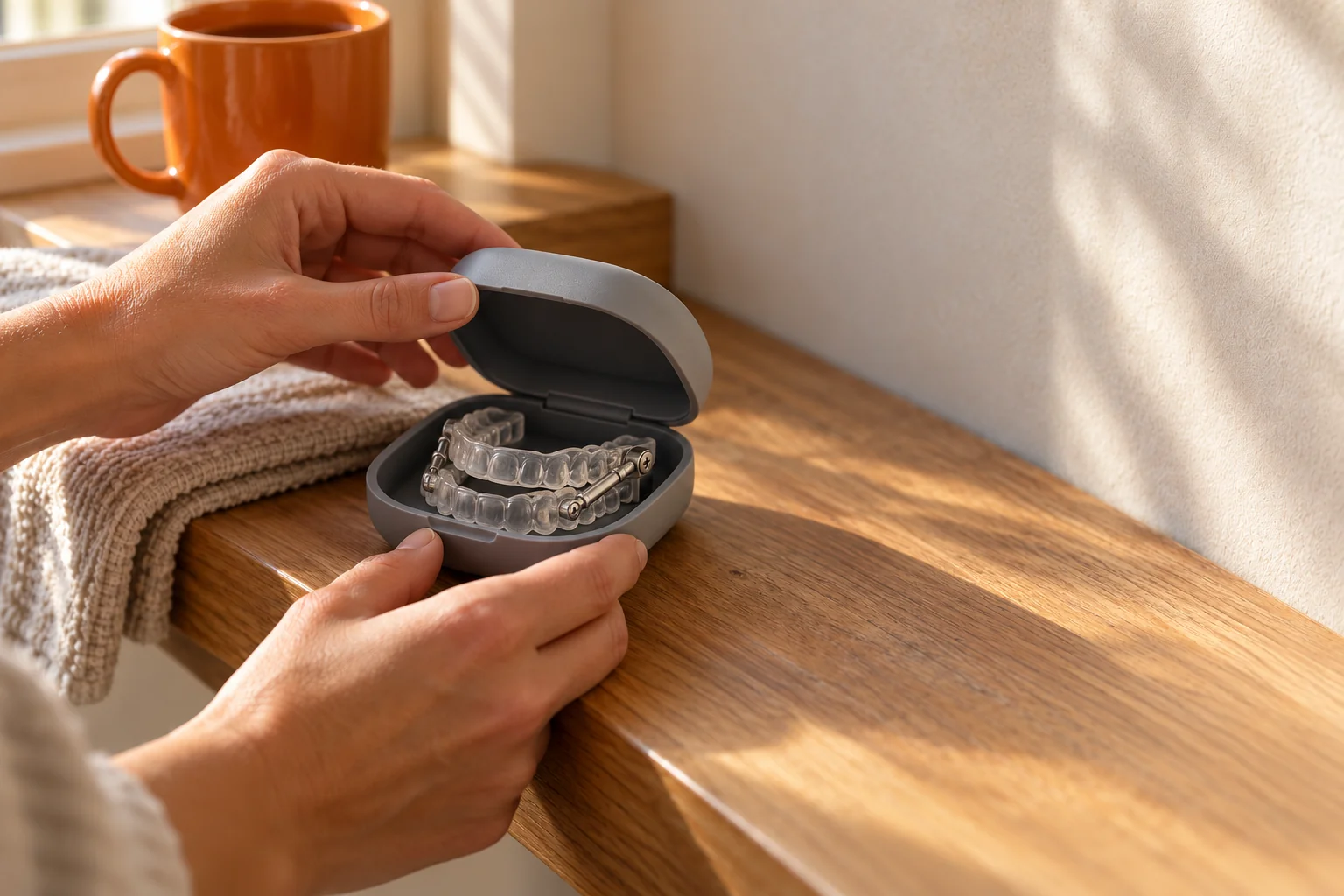
An oral appliance, also called a mandibular advancement device, is a custom mouthpiece a dentist fits to your teeth. It holds your lower jaw slightly forward while you sleep, which helps keep your airway open. It tends to suit mild to moderate apnea, or more severe apnea when CPAP is not tolerated. It involves a dentist trained in sleep medicine, gradual adjustments, and a follow-up test. Tradeoffs include jaw soreness, tooth pressure, or bite changes, especially early on. Clinical guidelines from the American Academy of Sleep Medicine and the American Academy of Dental Sleep Medicine say sleep physicians should consider an oral appliance, rather than no treatment, for adults who cannot tolerate CPAP or prefer another option (Ramar et al., 2015).
- 02
2. Positional therapy
Some people have apnea mostly when they sleep on their back. A wearable device that keeps them on their side can reduce breathing events. It is low cost and low risk, but it only helps if a sleep study shows your apnea is position-dependent.
- 03
3. Weight loss
Extra weight around the neck can narrow the airway, so losing weight often lowers apnea severity. Results vary widely. In December 2024, the FDA approved Zepbound (tirzepatide) for moderate to severe obstructive sleep apnea in adults with obesity, to be used with a reduced-calorie diet and more physical activity (U.S. Food and Drug Administration, 2024). Whether it makes sense for you is a question for your physician.
- 04
4. Hypoglossal nerve stimulation
This implanted device, often known by the brand name Inspire, stimulates the nerve that controls your tongue so it does not block your airway. In the STAR trial, people with moderate to severe apnea who struggled with CPAP saw their apnea events drop by 68% at 12 months (Strollo et al., 2014). It requires surgery and strict eligibility checks.
- 05
5. Airway surgery
Procedures that remove or reshape tissue in the nose, throat, or jaw can help when a clear structural blockage exists. Surgery is the most invasive of the CPAP alternatives and usually comes after other options.
Is a mouth guard as good as CPAP?
On paper, CPAP usually lowers breathing events more (Ramar et al., 2015). In real life, the better treatment is often the one you actually use. Many people find an oral appliance easier to live with, so they wear it more nights. That is why it leads most lists of CPAP alternatives. Guidelines treat it as a solid option for people who cannot tolerate CPAP (Ramar et al., 2015).
For more on who a mouth guard suits, see our guide to whether a sleep apnea mouth guard is right for you.
Why CPAP felt impossible, and why it might not be about the mask
Insomnia and sleep apnea often show up together. Researchers call this comorbid insomnia and sleep apnea, or COMISA. Reviews report that roughly 30% to 50% of people with one condition also have the other (Sweetman, Lack, & Bastien, 2019).
After months or years of broken nights, your nervous system can learn to stay alert in bed instead of winding down. Researchers call this conditioned hyperarousal (a learned state of alertness tied to your bed). Now add a mask, a hose, and a soft hiss.
The struggle may not be about breathing at all. It may be about sleeping with any device, and no CPAP alternative changes that on its own.
The study that changed how experts see CPAP struggles
A randomized trial in Australia tested this directly. It enrolled 145 adults with both sleep apnea and insomnia. Half received four sessions of cognitive behavioral therapy for insomnia (CBT-I) before starting CPAP. The other half started CPAP as usual (Sweetman et al., 2019).
The CBT-I group used CPAP about 61 minutes more per night on average. They also accepted CPAP more often at the start (99% versus 89%) and saw greater improvement in insomnia severity by six months.
Treating the insomnia first helped people actually use their airway treatment. If you want to understand what CBT-I involves, here is how sleep coaching compares to CBT-I.
An ongoing trial is now testing oral appliance therapy in people with both conditions (ISRCTN Registry, n.d.). There are no results yet, so no one can promise the same effect.
Your device opens your airway. Coaching teaches you to sleep.
At Clementine, we see your airway treatment and your sleep habits as two different jobs.
Your physician or dentist handles the airway. Coaching handles the other half: the evening routine, the timing of your sleep, and a nervous system that has forgotten how to settle in bed. The Clementine Protocol is built on CBT-I methods, the same skills used in the trial above.
A mouth guard, an implant, or a second try at CPAP all work better when you can actually fall asleep wearing them. If you are curious why skills tend to outlast pills, our look at CBT-I versus sleeping pills over the long term lays out the evidence.
The uncomfortable habit that helps most
Get out of bed when you cannot sleep.
It sounds backward. But lying awake for long stretches teaches your brain that bed is a place to be alert. Getting up, doing something calm in low light, and returning only when sleepy rebuilds the link between bed and sleep.
It is hard for a week or two, and it is one of the most reliable parts of CBT-I. For more drug-free approaches, see our guide to improving sleep without medication.
What not to do
- 01
Do not just go without treatment.
Untreated sleep apnea can raise the risk of high blood pressure, heart disease, stroke, and type 2 diabetes (National Heart, Lung, and Blood Institute [NHLBI], 2025). If you stopped CPAP, tell your physician, even if it feels awkward.
- 02
Do not buy an online mouth guard as a CPAP replacement.
Over-the-counter guards are not fitted or monitored. A dentist-fitted device with a follow-up test is the standard.
Questions to bring to your next appointment
Still unsure about specialist care? Our guide on whether you need a sleep doctor can help you decide. Then bring these questions.
- 01
Severity
How severe is my sleep apnea, and which CPAP alternatives fit that level?
- 02
Position
Is my apnea worse on my back? Would positional therapy help?
- 03
Oral appliance
Am I a candidate for an oral appliance? Can you refer me to a dentist trained in sleep medicine?
- 04
Weight
Would weight loss or medication change my options?
- 05
Follow-up
How will we confirm my new treatment is working?
- 06
Insomnia
Could insomnia be part of why CPAP was hard for me?
Progress over perfection
Stopping CPAP does not mean you failed treatment. There are real CPAP alternatives for your airway, and real help for the part of you that learned to stay awake in bed.
Your physician or dentist guides the airway decision. Coaching never replaces that care. It works alongside it, so whichever of the alternatives to CPAP you choose has a better chance of sticking.
When you are ready for a personalized starting point, a complimentary assessment and consult with a board-certified sleep professional can help you build the Clementine Protocol around your treatment and schedule.
Frequently asked questions
What is the best alternative to a CPAP machine?
Do mouth guards for sleep apnea really work?
Is Inspire better than CPAP?
Can losing weight get rid of sleep apnea?
Can a sleep coach help if I couldn't stick with CPAP?
Sources & clinical context
- 1.Ramar, K., Dort, L. C., Katz, S. G., Lettieri, C. J., Harrod, C. G., Thomas, S. M., & Chervin, R. D. (2015). Clinical practice guideline for the treatment of obstructive sleep apnea and snoring with oral appliance therapy: An update for 2015. Journal of Clinical Sleep Medicine, 11(7), 773-827.
- 2.Rotenberg, B. W., Murariu, D., & Pang, K. P. (2016). Trends in CPAP adherence over twenty years of data collection: A flattened curve. Journal of Otolaryngology - Head & Neck Surgery, 45, Article 43.
- 3.Strollo, P. J., Jr., et al. (2014). Upper-airway stimulation for obstructive sleep apnea. New England Journal of Medicine, 370, 139.
- 4.Sweetman, A., Lack, L., & Bastien, C. (2019). Co-morbid insomnia and sleep apnea (COMISA): Prevalence, consequences, methodological considerations, and recent randomized controlled trials. Brain Sciences, 9(12), 371.
- 5.Sweetman, A., Lack, L., Catcheside, P. G., Antic, N. A., Smith, S., Chai-Coetzer, C. L., Douglas, J., O'Grady, A., Dunn, N., Robinson, J., Paul, D., Williamson, P., & McEvoy, R. D. (2019). Cognitive and behavioral therapy for insomnia increases the use of continuous positive airway pressure therapy in obstructive sleep apnea participants with comorbid insomnia: A randomized clinical trial. Sleep, 42(12), zsz178.
- 6.U.S. Food and Drug Administration. (2024, December 20). FDA approves first medication for obstructive sleep apnea [Press release].
- 7.ISRCTN Registry. (n.d.). Co-morbid insomnia and OSA (COMISA) treatment trial using oral appliance therapy (ISRCTN24516612).
- 8.National Heart, Lung, and Blood Institute. (2025, January 9). Sleep apnea: Living with. National Institutes of Health.
Ready to build better sleep, for good?
Begin tonight