


First weeks on CPAP
Getting used to CPAP: why month one matters
The short answer
Getting used to CPAP is a learning curve measured in weeks, not nights. In a UK study of 1,000 people, much of the change in how people used their device happened in the first two weeks, and the first month largely set the pattern for month three. Struggling early is common. It is also the best time to get help.
The essentials
Key takeaways
The core of this article, in a few lines.
- Why getting used to CPAP is a learning curve, not a sign the device is wrong for you
- Which mask and comfort problems belong with your clinician or supplier
- How to practice with the mask while awake so it stops feeling like a threat
- What to do when you wake up and the mask is off
Getting used to CPAP takes weeks, not nights
Getting used to CPAP is a learning curve measured in weeks, not nights. In a UK study of 1,000 people, much of the change in how people used their device happened in the first two weeks, and the first month largely set the pattern for month three (Dielesen et al., 2025). Struggling early is common. It is also the best time to get help.
You wake up and the mask is on the floor. Your partner, so relieved when the snoring stopped, asks how the night went. A quiet thought is getting louder: maybe CPAP just is not for me.
That thought is understandable, and usually wrong. Most advice stops at an equipment list. Those things matter, but they skip the bigger point: your body is learning a new bedtime cue, and learning takes practice.
Check these with your clinician or supplier first
Rule out the equipment first. These are not things to adjust on your own. Bring them to your prescribing clinician or equipment supplier:
- 01
Mask fit and leaks
Leaking air, a mask that presses or slides, or red marks in the morning are reasons to ask about a different size or style.
- 02
Pressure that feels too strong
Ask whether a ramp or other comfort setting is right for you.
- 03
Dry mouth or a stuffy nose
Ask about humidity options.
- 04
Your device data
Ask to review leaks and nightly use in the first two weeks, not only at the 90-day check.
Early help is part of good CPAP care
The American Academy of Sleep Medicine recommends education when people start CPAP and suggests behavioral and troubleshooting support in the first weeks (Patil et al., 2019). Early help is part of good care. If you are past the first month and still feel drained, see why you might still feel tired on CPAP.
Why the first month of CPAP shapes the months after
The UK study found six distinct patterns of early use across the first three months. Among people not using their device regularly at month three, 98% were already in that pattern by the end of month one. More than half changed how much they used it during the first month, mostly in the first two weeks (Dielesen et al., 2025).
A smaller Italian study agrees. Among 62 people followed for six months, those who found the pressure comfortable at the start and judged the therapy positively were more likely to keep using it well (Amendolara et al., 2025).
First impressions are sticky. Not because some people are built for CPAP and others are not, but because early nights teach your brain what the mask means. That is why getting used to CPAP deserves attention in week one, not month three.
Feeling like you can't breathe in the mask is common
Many people say the mask feels smothering at first, and they pull it off before they can think. In one study of 97 adults starting CPAP, 63% showed claustrophobic tendencies with the mask, and those tendencies were linked to lower use at one week and one month (Edmonds et al., 2015).
Your airway is open and air is flowing. But something on your face, plus the feel of pressure, can set off an alarm response before you are fully awake, and the mask feels like the cause. Each time you pull it off, the relief teaches your nervous system that removing the mask is how you stay safe.
Alarm responses can quiet down with calm, repeated exposure. This is called habituation (your body's alarm getting quieter as it learns something is safe). For many people, getting used to CPAP starts right here.
The myth that struggling means CPAP isn't for you
A common first-month belief is: "If CPAP feels this hard, it must not be right for me." The research suggests otherwise. Early struggle is the normal start of a learning curve, and the first weeks are when that curve is most open to change (Dielesen et al., 2025).
Some people also arrive with a bed that already felt like a place to lie awake. Trouble falling or staying asleep often shows up alongside sleep apnea, as explained in having insomnia and sleep apnea at the same time. In a trial of 145 adults with both, four sessions of cognitive behavioral therapy for insomnia (CBT-I, a skills-based approach to sleep) before starting CPAP led to about 61 more minutes of nightly CPAP use than usual care. Among those who had CBT-I first, 99% accepted CPAP at the start, compared with 89% with usual care (Sweetman et al., 2019).
Your device opens your airway. Coaching teaches you to sleep.
How to practice with your CPAP mask while you're awake
This is the uncomfortable habit most people skip, because it feels silly. It gives your nervous system calm, boring time with the mask when nothing is at stake. In a small case series, people who did graded practice with a sleep psychologist used CPAP longer afterward (Means & Edinger, 2007). Daytime practice adds to night use as prescribed. It never replaces it. If panic stays strong after a week or two, tell your clinician.
- 01
Hold the mask
Sit comfortably and hold it to your face for a few slow breaths.
- 02
Add the straps
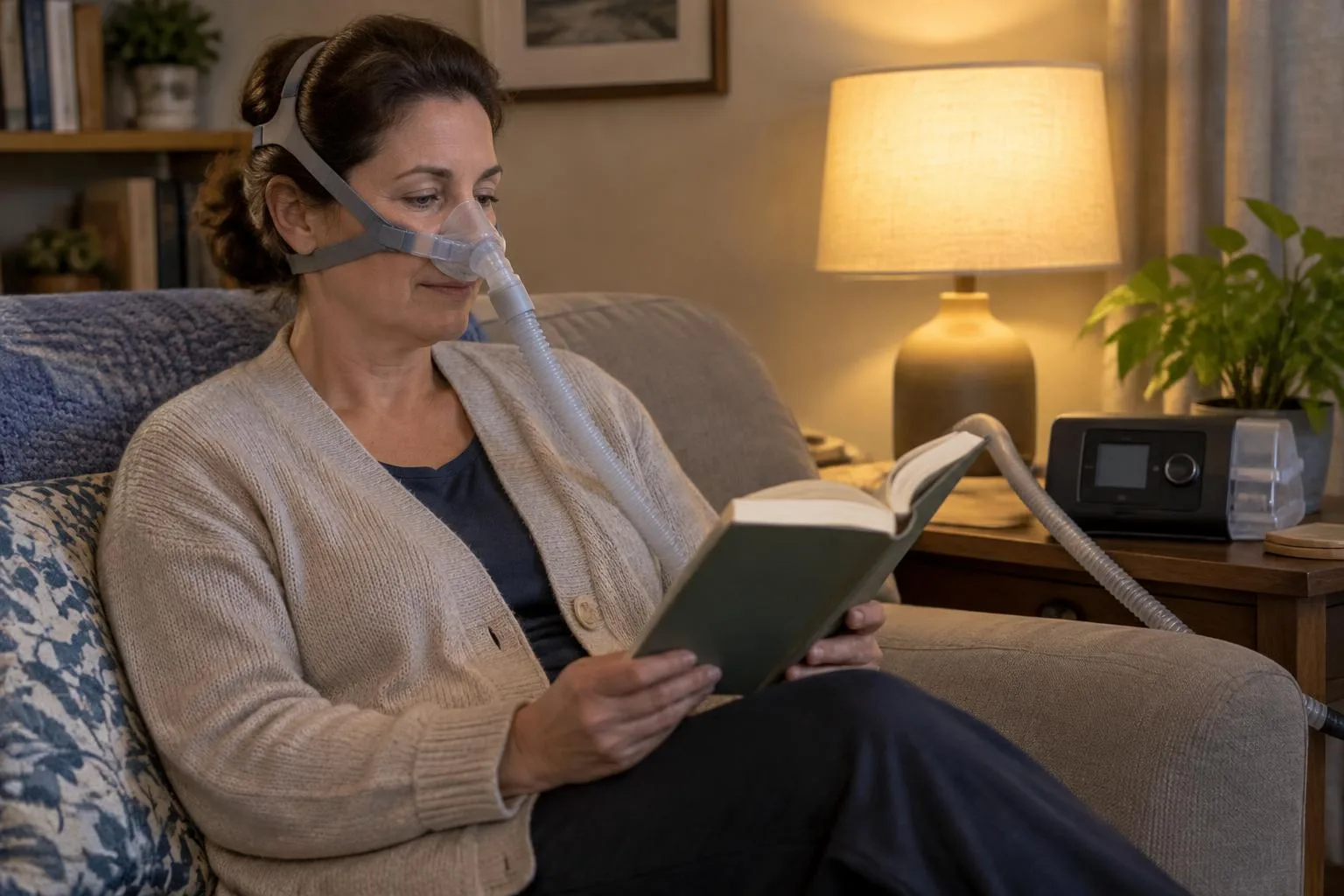
Wear the headgear while you read or watch something you enjoy.
- 03
Turn the air on
Switch the machine on while you sit up. Notice you are breathing fine.
- 04
Practice lying down
Wear the full setup in bed for a short stretch before your usual bedtime.
- 05
Repeat daily
Short, regular practice beats one long, stressful session.
What to do when the CPAP mask comes off at night
You wake up and the mask is off. The goal is simple: put it back on, calmly, without turning the moment into a test. If early wake-ups are a pattern, it helps to understand why you keep waking up at 2am.
Put the mask back on right away, because every hour you wear it counts. First, take a few long, easy breaths. If you are wide awake and frustrated, get up briefly, do something quiet in dim light, then return to bed and put the mask on when you feel sleepy.
If your mind starts racing, these ideas on how to stop overthinking at night can help. Each calm refit is part of getting used to CPAP, because it teaches your brain the mask belongs in bed.
What not to do in your first weeks
- 01
Do not change settings yourself
Pressure, ramp, and humidity belong with your clinician or supplier.
- 02
Do not take nights off to catch up on rest
Skipped nights slow the learning curve and bring back the breathing pauses your device prevents.
- 03
Do not judge CPAP by one bad night
Look at the trend across a week or two.
- 04
Do not wait for the 90-day appointment
Struggling in week one? Call in week one.
- 05
Do not fight the mask in the dark
Lying there tense teaches your body the wrong lesson.
What the research can and can't tell you
The evidence has limits. Early patterns in the UK study predicted later use, but they do not prove early struggle locks you in, and the study's authors suggest the patterns can guide tailored support (Dielesen et al., 2025). The Italian study was small, and many people left before the six-month follow-up (Amendolara et al., 2025). Exposure research so far is a case series, not a controlled trial (Means & Edinger, 2007). Only people with both sleep apnea and insomnia took part in the CBT-I trial (Sweetman et al., 2019).
Together they send one signal: habits around the device form early, and support in that window seems to matter. A rough first month is not a verdict. It is a sign to get more support now.
Your checklist for getting used to CPAP this month
- 01
Book a check
Ask your clinician or supplier for a mask fit and data review in the first two weeks.
- 02
Practice daily
Wear the mask while awake for a few minutes every day.
- 03
Keep steady times
Hold your bedtime and wake time steady, even after a rough night.
- 04
Refit calmly
When the mask comes off at night, slow your breathing and put it back on.
Progress over perfect nights
Getting used to CPAP is rarely a straight line. Some nights the mask will feel like part of you. Others will feel like the first night again. That is normal and does not erase your progress.
At Clementine, the Clementine Protocol we build with clients works alongside the device, never instead of it. Its consistency and wind-down pillars help your body relearn that bed is calm. Coaching never treats sleep apnea or adjusts a device. Your clinician owns that care.
If you want a personalized starting point, a complimentary assessment can help you build the Clementine Protocol around your schedule and your first weeks with the device.
Frequently asked questions
How long does it take to get used to CPAP?
Why does wearing a CPAP mask make me anxious?
What should I do if I take my CPAP mask off during the night?
Can I practice wearing my CPAP mask during the day?
Sources & clinical context
- 1.Amendolara, M., Di Lecce, V., Santomasi, C., Quaranta, V. N., Portacci, A., Dei Lazzaretti, I., Cuccaro, L. A. S., Casparrini, M., Spierto, S., Picerno, V., De Robertis, C., Quaranta, S., Dragonieri, S., & Carpagnano, G. E. (2025). The impact of PAP therapy first impression on short-term treatment adherence. Sleep and Breathing, 29, 152. https://doi.org/10.1007/s11325-025-03320-4
- 2.Dielesen, J., Ledwaba-Chapman, L. J., Kasetti, P., Husain, N. F., Skinner, T. C., Pengo, M. F., Whiteman, T., Asimakopoulou, K., Merritt, S., Jones, D., Dickel, P., Pulakal, S., Ward, N. R., Pepperell, J., Steier, J., & Sathyapala, S. A. (2025). Six early CPAP-usage behavioural patterns determine peak CPAP adherence and permit tailored intervention, in patients with obstructive sleep apnoea. Thorax, 80(5), 300-308. https://doi.org/10.1136/thorax-2024-221763
- 3.Edmonds, J. C., Yang, H., King, T. S., Sawyer, D. A., Rizzo, A., & Sawyer, A. M. (2015). Claustrophobic tendencies and continuous positive airway pressure therapy non-adherence in adults with obstructive sleep apnea. Heart and Lung, 44(2), 100-106. https://doi.org/10.1016/j.hrtlng.2015.01.002
- 4.Means, M. K., & Edinger, J. D. (2007). Graded exposure therapy for addressing claustrophobic reactions to continuous positive airway pressure: A case series report. Behavioral Sleep Medicine, 5(2), 105-116. https://doi.org/10.1080/15402000701190572
- 5.Patil, S. P., Ayappa, I. A., Caples, S. M., Kimoff, R. J., Patel, S. R., & Harrod, C. G. (2019). Treatment of adult obstructive sleep apnea with positive airway pressure: An American Academy of Sleep Medicine clinical practice guideline. Journal of Clinical Sleep Medicine, 15(2), 335-343. https://doi.org/10.5664/jcsm.7640
- 6.Sweetman, A., Lack, L., Catcheside, P. G., Antic, N. A., Smith, S., Chai-Coetzer, C. L., Douglas, J., O'Grady, A., Dunn, N., Robinson, J., Paul, D., Williamson, P., & McEvoy, R. D. (2019). Cognitive and behavioral therapy for insomnia increases the use of continuous positive airway pressure therapy in obstructive sleep apnea participants with comorbid insomnia: A randomized clinical trial. Sleep, 42(12), zsz178. https://doi.org/10.1093/sleep/zsz178
Ready to build better sleep, for good?
Begin tonight