


Reading your tracker
Why is my deep sleep so low
The short answer
Deep sleep is mostly decided in the first one to two hours of the night, and it naturally declines with age. One low night means almost nothing. A number that stays low usually reflects a nervous system still on alert early in the night, not a defect a gadget can undo.
The essentials
Key takeaways
The core of this article, in a few lines.
- Deep sleep is front-loaded into the first one to two hours of the night, so a low number reflects what your nervous system did early on.
- Deep sleep naturally declines with age, and one low night is meaningless; judge the two-week trend.
- Late drinks, late heavy meals, and intense late work suppress slow-wave sleep by keeping you in a high-alert state.
- Trackers estimate stages and can mislead; alcohol can inflate one night's deep-sleep number while wrecking overall quality.
- The real change is a learnable wind-down that settles the nervous system upstream of bedtime, not a gadget or pill.
Staring at 34 minutes of deep sleep and feeling like you failed
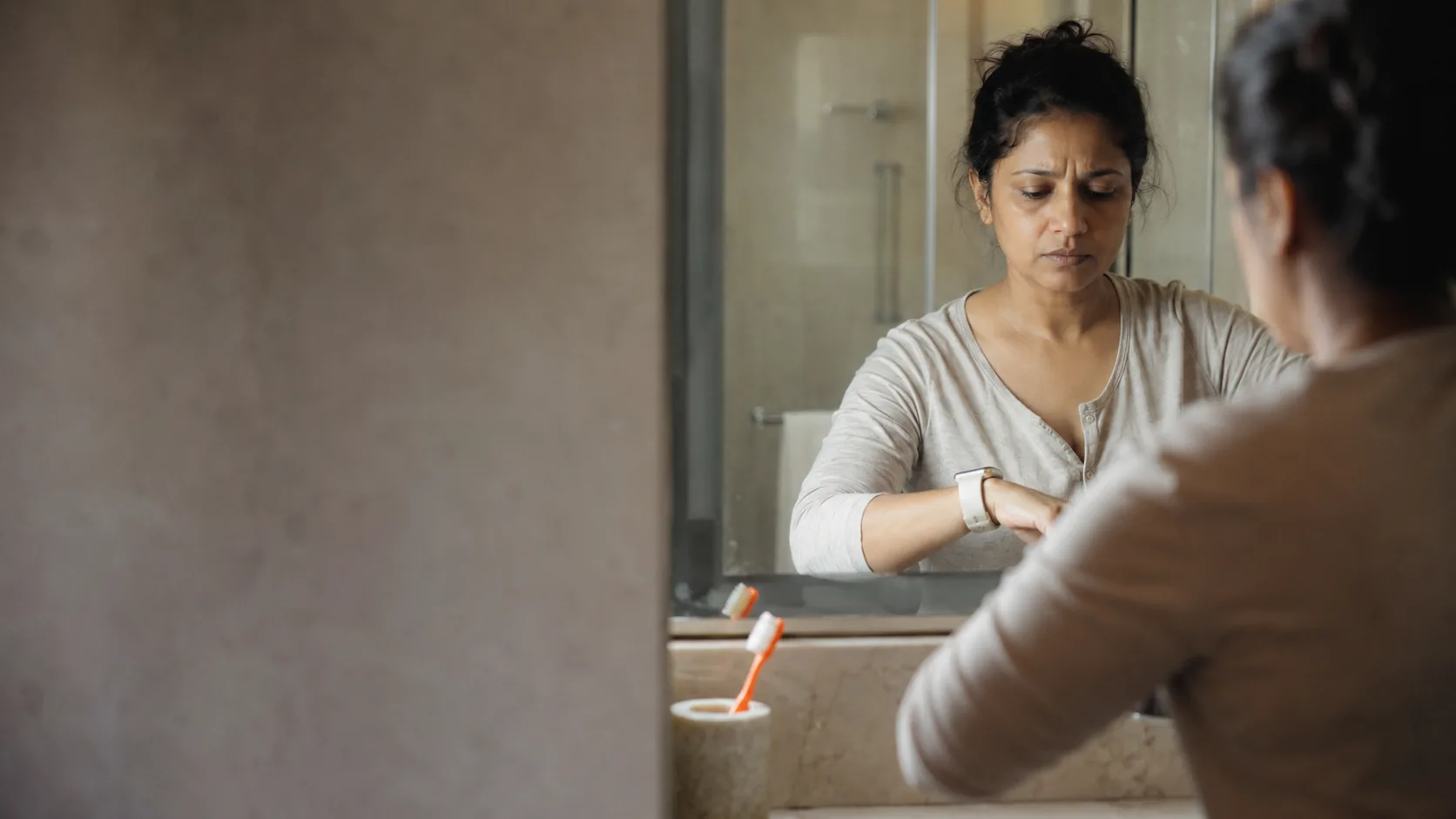
It is 6:45am. Coffee in one hand, thumb on the sleep-stages screen, and there it is again: deep sleep at 34 minutes. You slept seven or eight hours, and your own wrist is telling you your body is running behind.
Most advice makes it worse with generic checklists that never explain the one thing that determines the number. Deep sleep, also called slow-wave sleep, is concentrated in the first one to two NREM cycles, not spread evenly across the night.
So a low deep-sleep score is rarely a deep-sleep problem. It is a first-two-hours problem, which moves the real lever from chasing a metric to setting up the start of your night.
The mechanism most advice skips: deep sleep is front-loaded
Sleep runs in roughly 90-minute cycles. Slow-wave sleep dominates the first couple of cycles, then tapers as REM takes a bigger share toward morning. This early window is when the body secretes most of its growth hormone and clears metabolic waste from the brain.
Anything that keeps your nervous system in a high-alert state during those first cycles truncates slow-wave sleep. A racing mind, a nightcap, a late heavy meal, or intense late screens all raise cortisol at the wrong moment.
That is why you can log eight hours and still see a thin deep-sleep number. The hours were there; the early-night calm was not.
What is actually normal, so you can calibrate
Deep sleep is a smaller slice of the night than most tracker-checkers expect, and it shrinks with age. Young adults typically spend roughly 15 to 20 percent of the night in deep sleep, and by your 40s and 50s that share commonly drifts lower.
For many adults that lands somewhere between 45 and 100 minutes, though healthy people vary widely. One low night after travel or a late dinner is noise; the pattern over a couple of weeks is the signal.
The habits that actually move the needle
Because deep sleep is earned in the first two hours, the habits that matter most settle the nervous system before the night starts.
- 01
Build a consistent wind-down
A predictable, lower-stimulation last hour tells your nervous system it is safe to power down, protecting the early deep cycles.
- 02
Eat your last big meal earlier
Late heavy eating keeps digestion and core temperature up when your body is trying to drop into slow-wave sleep.
- 03
Keep a steady sleep and wake time
Regularity strengthens the sleep pressure and circadian timing that drive deep sleep more reliably than any single-night trick.
- 04
Move your body during the day
Regular activity is one of the few things shown to increase slow-wave sleep, as long as intense sessions are not right before bed.
Wearables: turn the number into a behavior, not a verdict
Oura, WHOOP, Apple Watch, and Fitbit estimate sleep stages from movement, heart rate, and heart-rate variability. They are useful for trends but are estimates, not a medical readout, and can be wrong on any night.
Alcohol is the clearest example of a misleading number: presleep alcohol can briefly inflate the early deep-sleep reading while degrading overall architecture and raising nighttime cortisol. Oura's 2025 analysis of more than 600,000 members found alcohol-tagged nights consistently disrupt sleep quality.
Do not react to one screen. Tag your nights, watch the two-week trend, and test one change at a time so the data becomes a behavior-change loop.
The uncomfortable habit most readers avoid: drop the nightcap
A nightcap feels relaxing, but as your body metabolizes it overnight it fragments sleep and keeps your nervous system activated during the exact early cycles when deep sleep should be forming.
What not to do
Do not buy another device to chase the number; a second tracker gives you more data, not more deep sleep. Do not reach for supplements or sleeping pills first, since many sedating aids suppress the slow-wave sleep you are trying to build.
Do not panic over a single low night, because the stress itself suppresses deep sleep. And do not do intense work or workouts right up to bedtime, which keeps you sympathetic-dominant when you need to settle.
A simple checklist for tonight
- 01
Eat earlier
Finish your last large meal a few hours before bed.
- 02
Skip the drink
Skip or move up the evening alcohol.
- 03
Calm the last hour
Build a lower-light last hour with the same routine each night.
- 04
Anchor your wake time
Keep your wake time steady, even after a rough night.
- 05
Read the trend
Judge deep sleep on a two-week trend, not one screen.
When to talk to a doctor
Most low deep-sleep numbers are behavioral and changeable. But if a persistently low number comes with loud snoring, gasping, morning headaches, unrefreshing sleep, or heavy daytime sleepiness, that warrants a conversation with a physician to rule out conditions like sleep apnea.
The number is information, not a verdict, and sometimes the information is worth a professional look.
Frequently asked questions
What is a normal amount of deep sleep for my age?
Can one bad night of deep sleep actually hurt me?
Why does my deep sleep drop when I have a drink in the evening?
Can I trust my tracker's deep-sleep number at all?
What's the single most effective way to increase deep sleep naturally?
Sources & clinical context
- 1.Colrain, I. M., et al. (2024). Altered sleep architecture following consecutive nights of presleep alcohol. SLEEP, Oxford Academic.
- 2.Ebrahim, I. O., Shapiro, C. M., Williams, A. J., & Fenwick, P. B. (2013). Alcohol and sleep I: effects on normal sleep. Alcoholism: Clinical and Experimental Research, 37(4), 539-549.
- 3.Oura (2025). What 600,000+ members' data reveals about alcohol and sleep. Oura Research.
- 4.National Institute of Neurological Disorders and Stroke (2023). Brain basics: understanding sleep. NIH.
Ready to build better sleep, for good?
Begin tonight